
Data Centers Not Only Need Backup Power — They Need Energy Certainty
Beyond Backup Power: Data Centers Need Energy Certainty
Data centers have always been engineered around uptime. Redundancy layers, backup generators, and failover systems all exist to answer one critical question: What happens when the power goes out?
But that question is no longer enough.
Today’s challenge is not just outages—it is uncertainty. Power demand is rising faster than infrastructure can keep up. Grid constraints, energy pricing volatility, increasing load density, and permitting complexities all affect how reliably a facility can operate.
Backup power still matters. But what data centers truly need now is energy certainty.
The Problem Is Not Failure — It Is Variability
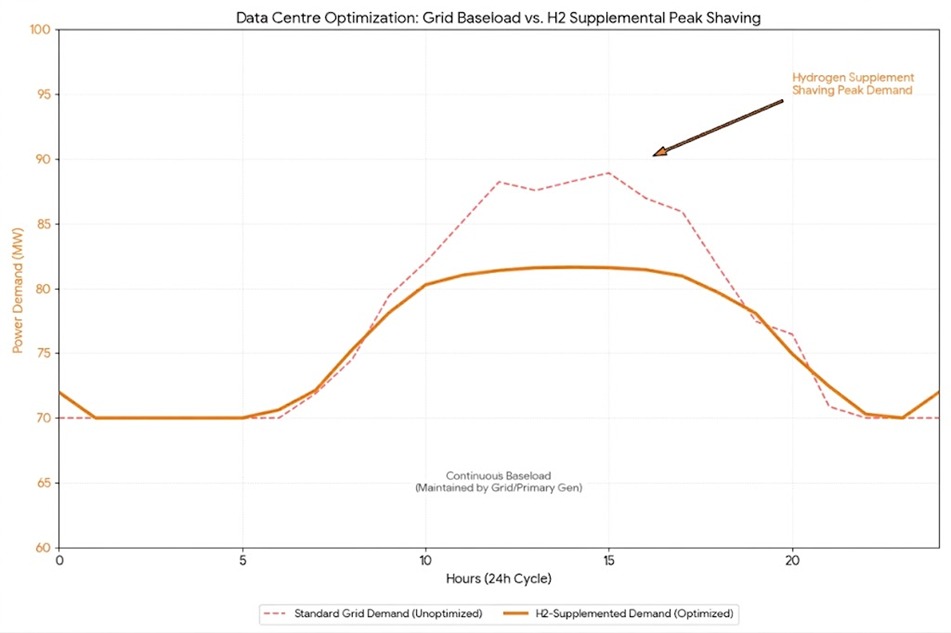
Most data centers are not challenged solely by a total loss of power. Instead, they face demand spikes, grid congestion, higher-density compute loads, and energy systems designed for yesterday’s requirements.
Traditional backup infrastructure is reactive—it responds after a disruption occurs.
EMAP™ (Energy Modeling and Advanced Planning) shifts the approach. It flattens demand curves, anticipates risk, and enables proactive planning before problems become expensive, disruptive, or limiting.
What EMAP™ Means for Data Centers
EMAP™ stands for Energy Modeling and Advanced Planning. It is not tied to a specific fuel or technology. Instead, it is an energy-agnostic framework designed to optimize performance, resilience, and cost.
With EMAP™, operators can:
- Model real-world demand and peak load scenarios
- Design infrastructure based on actual load behavior—not assumptions
- Identify grid, storage, and backup constraints before they impact uptime
- Deploy the right technologies for the right roles within the energy ecosystem
Where Hydrogen Fits
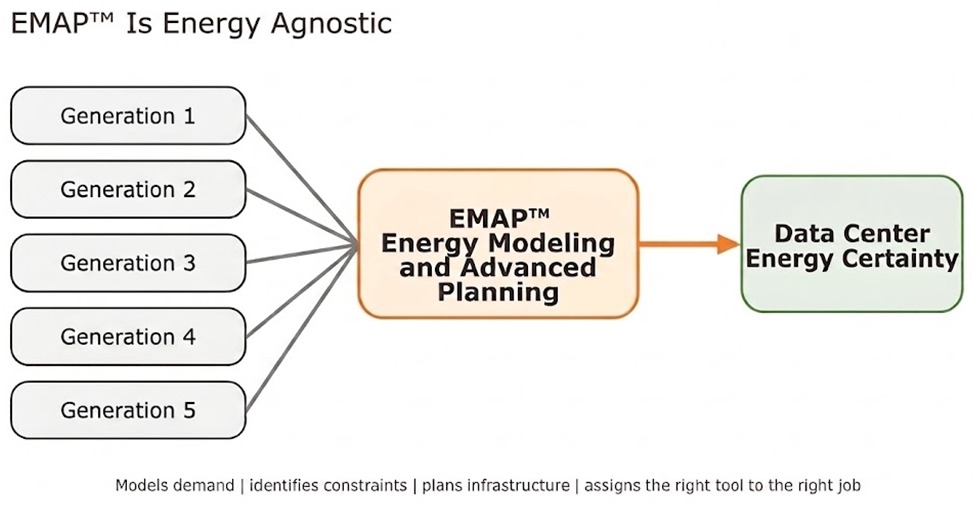
Because EMAP™ is energy-agnostic, it selects solutions based on performance, cost, and reliability. Within this framework, hydrogen plays a strategic and targeted role.
1. Peak Load Management
Hydrogen can help manage recurring demand spikes identified through modeling. By reducing strain on the grid, it minimizes peak demand exposure and associated costs.
2. Resilient Backup Power
Hydrogen enhances backup strategies by reducing reliance on delivered diesel—especially in environments where runtime requirements, emissions regulations, or fuel logistics present risks.
3. System Flexibility
Rather than acting as a last-resort solution, hydrogen becomes part of an integrated energy strategy. This improves adaptability, scalability, and long-term resilience.
Energy Certainty Is the New Standard
Energy certainty means understanding how systems behave before stress impacts operations. It leads to fewer surprises, improved cost control, and greater confidence that growth will not be constrained by energy availability.
For data centers, this is quickly becoming a competitive advantage. Facilities that proactively model and manage energy will outperform those that rely solely on expanding backup capacity.
The ESSNA™ Perspective
At ESSNA™, we approach data center energy through EMAP™: Energy Modeling and Advanced Planning.
We do not begin with a predefined technology. Instead, we start by analyzing the load curve, operational constraints, and potential risks.
Where hydrogen adds value — peak shaving and backup power — we integrate it strategically within a broader energy plan. The result is a clearer, more reliable path to energy certainty.
Final Thought
As data centers continue to scale, success will no longer be defined by how systems respond after failure—but by how effectively operators anticipate and manage energy challenges before they arise.
Reliability is no longer reactive — It is designed upstream.
Within this framework, hydrogen is not the entire solution—but when applied strategically, it becomes a powerful enabler. It supports peak load management, strengthens backup resilience, and reduces dependence on delivered fuels.
Used correctly, hydrogen does not replace the system—it enhances how the system performs.
Energy Security Services North America Inc.
energysecurity-na.com